Most hand safety programmes start after an injury — glove selection, toolbox talks, posters, and reminders. PSC Hand Safety webinars start earlier, with the task. We help teams identify where hands enter hazardous zones during normal work and show how exposure can be reduced using no-touch methods, push/pull tools, magnetic tools, taglines, fixtures, distance tools, custom task interfaces, and improved work methods.
Most hand safety training focuses on awareness, glove selection, safe behaviour, and reminders. These are useful, but they are incomplete. Workers continue placing hands into pinch, crush, caught-between, burn, cut, and line-of-fire zones because the task still requires the hand to guide, hold, align, push, pull, lift, retrieve, or stabilise something.
When the task demands hand entry and no engineered alternative has been provided, training and PPE become the primary control by default — not because that is the right hierarchy, but because nothing else has been done. A glove does not prevent a crush event between a suspended mould box and its support frame. A toolbox talk does not prevent the hand from entering the pinch point on a finishing line.
Zero hand injuries does not always mean zero hand exposure. A plant may complete months without a recorded injury while workers continue placing their hands into hazardous zones every shift. When the injury finally occurs, it appears sudden — but the exposure was present throughout.
The question is not only "what glove is the worker wearing?" The deeper question is "why does the hand need to be there at all?"
PSC Hand Safety webinars address this question directly. Instead of beginning with PPE selection, sessions begin with the task — where hands enter the hazard, what the hazard type is, what the task function requires, and what control can engineer the hand out of the exposure zone without compromising the work.
Webinars and demonstrations do not replace site risk assessment, LOTO procedures, lifting plans, or engineering controls. They help teams identify where exposure occurs and what categories of control to investigate further.
Topics are practical and industrial. Sessions use real task examples, real tool categories, and where task photos have been submitted in advance, real content from the customer's own operations.
Why zero injuries is not the same as zero exposure, and how to measure exposure before injury confirms it.
Why engineering controls come before PPE, and what that means in practice for industrial hand safety tasks.
How to identify the specific moment and location where the hand crosses into a pinch, crush, or line-of-fire zone during normal work.
Taglines for swing and directional control. Push/pull tools and magnetic tools for final positioning. Why hands must not be in the load path during crane operations.
When and how push/pull tools create distance between the hand and the hazard. Load positioning, tray adjustment, component alignment, and section handling.
What magnetic tools do and do not do. Suitability factors: surface condition, coating, temperature, contact area, geometry. Magnetic force vs manual lifting limits.
Fingersavers, chisel holders, and pin-holding tools as the primary control. Why impact-resistant gloves are residual protection, not the solution, at the struck-hand exposure point.
Specialised hose handling tools for pressurised hose exposure. Tubular handling poles for pipe positioning. Stored-energy and line-of-fire exposure during connection and disconnection.
The correct role of PPE: after exposure has been reduced by engineering controls. How to select gloves for residual risk rather than as the primary control at crush and pinch points.
Most tasks can be addressed by a standard product category. How to match the task function — push, pull, guide, stabilise, align, retrieve — to the appropriate tool category.
When the task geometry, access constraints, load type, or surface condition means no standard tool fits. How to identify this and what a task-interface study involves.
What to photograph, what to include in the description, and how PSC Hand Safety uses task photos to map exposure before or after a session.
Sessions can be adapted for safety teams, operations and maintenance teams, plant leadership, department-specific crews, and multi-site programmes. All formats benefit from pre-session task photo submission.
For safety teams, EHS committees, and plant leadership. Introduces exposure-based hand safety thinking — hand exposure vs hand injury, the hierarchy of controls for hands, and the principle of engineering the hand out of the hazard. Does not require pre-session task submission, though task examples always improve relevance.
For EHS, maintenance, operations, rigging, production, and engineering teams. Covers the full range of hazard types, control categories, tool selection, and task-mapping methodology. Where task photos are submitted in advance, these are used as session content — making the webinar directly relevant to the customer's actual operations.
Content built around a specific work area or industry — rolling mills, foundries, aluminium plants, fabrication shops, oil and gas crews, marine yards, logistics teams, crane and rigging teams, maintenance teams, and shutdown crews. Draws on task photos from the customer's environment where available, and on PSC's existing industry-specific exposure data.
Customers send 5–10 task photos or short videos before the session. PSC Hand Safety reviews each task, maps the exposure type, identifies the hazard category, and builds the webinar content around the customer's actual tasks — not generic examples. This turns the session into an applied exposure review, not an awareness presentation.
After a webinar or task review session, PSC Hand Safety can provide suggested control categories, applicable tool options, customisation requirements where standard tools are insufficient, and next-step recommendations for each task reviewed. Helps teams translate session awareness into plant-level action.
For teams that want hands-on evaluation beyond an online session. Hosted at the PSC Hand Safety Experience Centre in Visakhapatnam. See control categories in practice, handle tools directly, evaluate reach and engagement geometry, and discuss customisation or new development requirements with PSC Hand Safety application engineers.
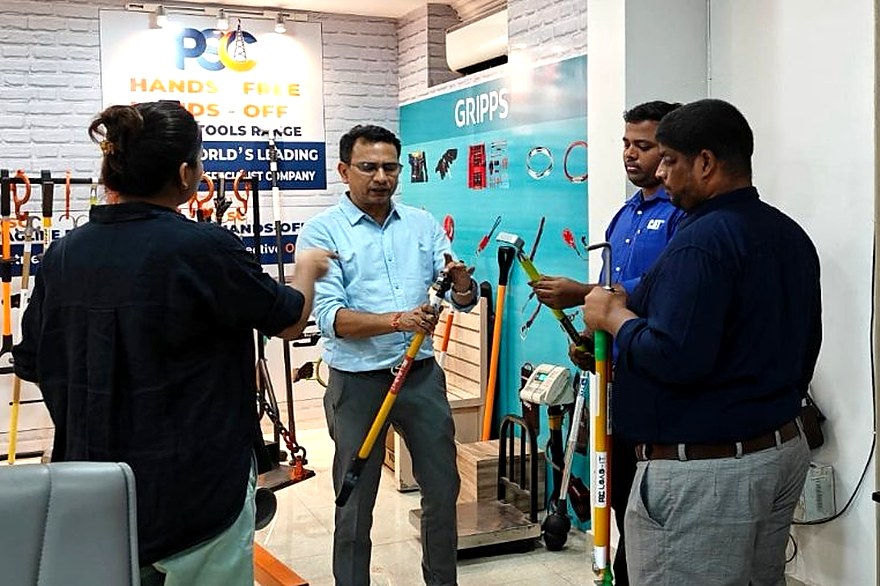
For teams that want to go beyond an online session. The Experience Centre allows customers to see how different hand safety control categories work in practice — and to evaluate whether a standard tool, a modified tool, or a custom task interface is needed for their specific operations. A recent visit by a team from Caterpillar's India facility is described below.
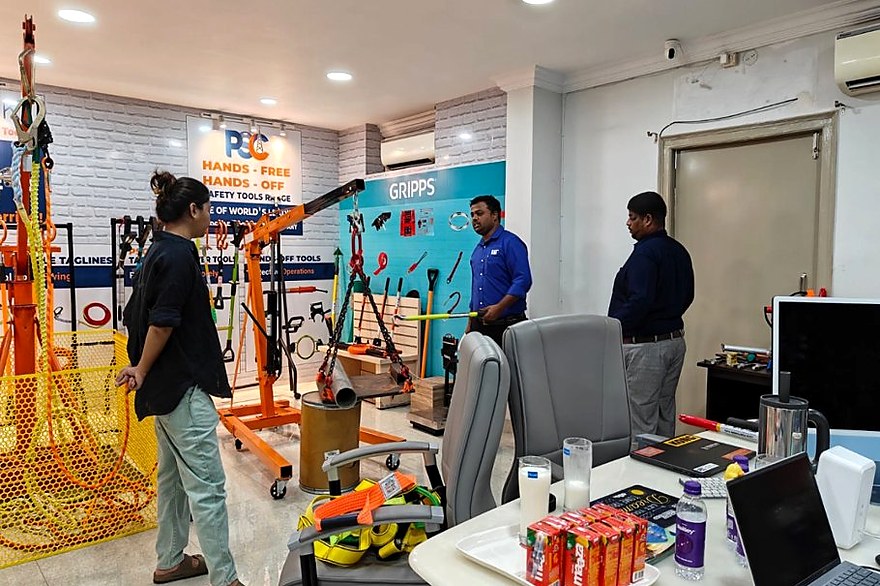
The Experience Centre is an application demonstration and exposure-reduction centre. It is not a product showroom. The purpose is to help teams move from awareness to practical selection — from understanding hand exposure in theory to seeing how different control categories work in practice, where each one is suitable, and where customisation or a change in work method may be required instead.
PSC Hand Safety can host safety teams, maintenance teams, plant engineers, rigging teams, EHS committees, procurement teams, and management teams by arrangement. Sessions are built around the customer's specific tasks wherever task photos or descriptions have been provided in advance.
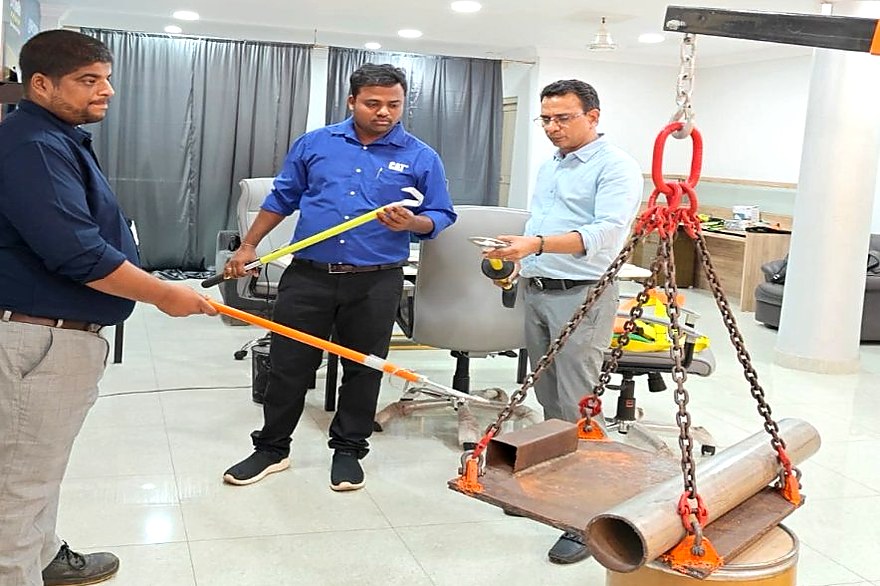
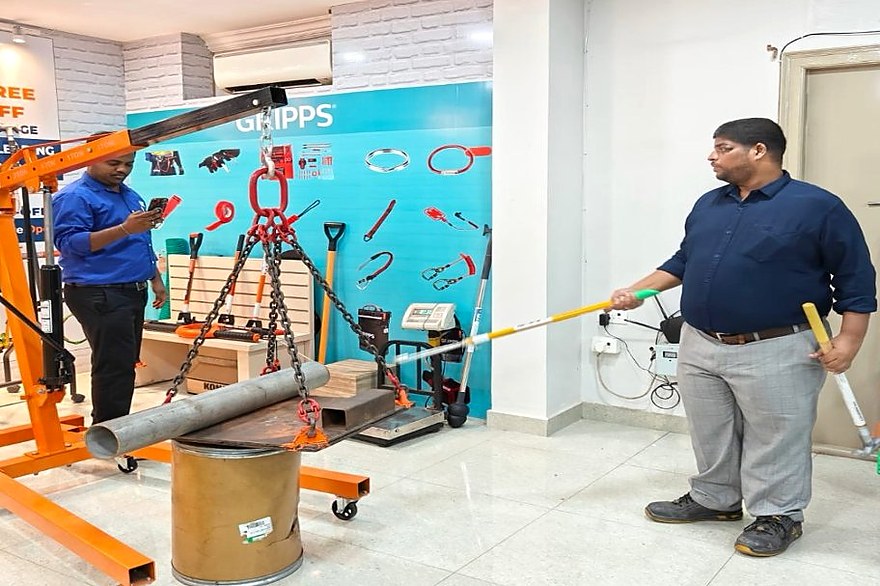
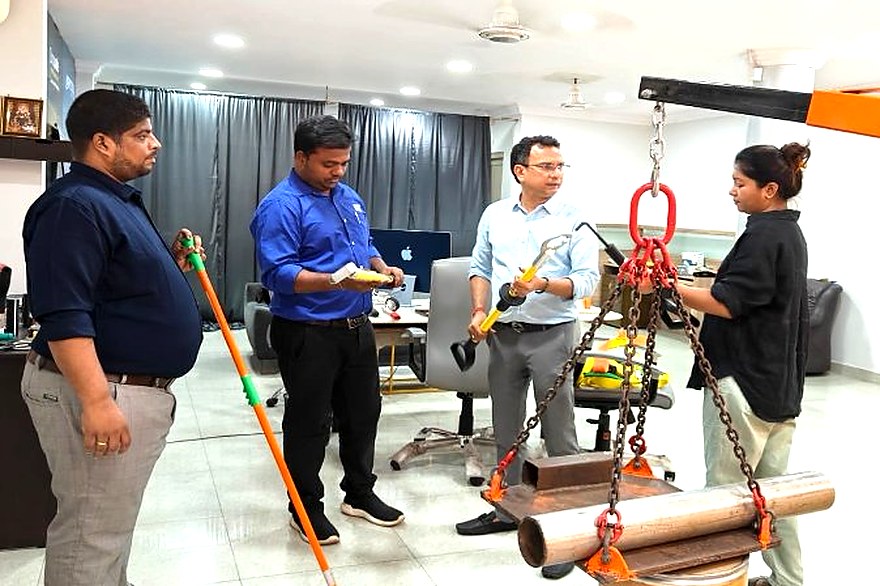
A team from Caterpillar's India facility visited the PSC Hand Safety Experience Centre in Visakhapatnam to evaluate how engineered hand safety controls can be applied to real assembly and material-handling tasks.
The session was not limited to a product walkthrough. It became a task-level discussion on how work is actually performed on the shop floor — where hands enter the task, why they enter, and whether an engineered interface can reduce that exposure without affecting usability.
Across assembly scenarios involving component mounting, alignment, suspended load control, and final positioning, the discussion repeatedly returned to the same critical phase: the last few millimetres of movement. This is where alignment corrections happen, components settle or rotate, and workers instinctively move their hands in to guide. This is also where the exposure often exists.
"If a tool does not integrate into the way the task is actually performed, the hand will come back."
The evaluation was not only about whether a tool could perform a function. It was about whether the tool would be practical in the task, acceptable for repeated use, and capable of replacing direct hand contact at the point of exposure.
The Caterpillar team brought detailed operational questions into the session — shift-level usage patterns, tool weight, operator fatigue, force transmission through the interface, reach distance, access angle, and application fit in production conditions.
The discussion was not simply: "Can this tool do it?" It was: "Should this tool be used here, and will operators actually use it every time?"
Magnetic handling tools were a key part of the discussion for ferrous assembly components. The session covered where a magnetic interface can reduce direct hand contact, where alignment and positioning can be controlled through the tool, and where magnetic tools may not be suitable.
Residual magnetism on castings was also discussed — not as a simple yes-or-no issue, but as part of the task evaluation: considering actual residual magnetism levels, downstream process impact, component sensitivity, and whether a magnetic, push-pull, hook, or custom interface is more appropriate for each task.
The session moved into practical demonstration and testing: suspended loads, push-pull and hook tools for alignment, magnetic contact on components, reach distance, engagement geometry, and operator positioning.
The evaluation showed both where standard tools can work and where task geometry, access angle, component surface, magnetic suitability, or production conditions may require a different category, modified configuration, or custom tool interface.
When a team brings real operational detail into the session — shift patterns, fatigue factors, access constraints, surface conditions — the evaluation moves from general tool selection to task-specific interface design. That is where the work of reducing hand exposure actually begins.
The PSC Experience Centre is available for teams who want to evaluate controls against their actual tasks — not a generic demonstration, but a session built around the work you need to address.
Not every hand exposure task can be solved by a standard product. In many industrial operations, the problem is not the worker's behaviour — it is the task interface. PSC Hand Safety can work with customers to study the task interface and develop or modify controls that reduce hand entry into the hazard zone.
The safest tool is not always the strongest or longest tool. It is the tool that correctly matches the task interface and keeps the hand out of the hazard zone.
PSC does not treat every task as a product-selling opportunity. Some tasks need a standard tool. Some need a modified tool. Some need a custom interface. Some require a change in work method, fixture design, lifting arrangement, isolation procedure, or engineering design — and a tool alone is not the answer.
Custom tools must be tested and validated for the task before full deployment. Magnetic tools are suitable only where material and surface conditions permit. PPE remains residual protection after exposure has been reduced — not a substitute for engineering controls.
Sessions are most effective when built around the customer's actual industry. Each sector has distinct exposure patterns, load types, hazard geometries, and control categories. Department-specific content uses task examples from the relevant environment.
Rolling mills, EOT crane bays, finishing lines, coil and bundle handling, plate and section handling, fabrication yards, and shutdown maintenance. Tagline and push/pull tool applications. Magnetic tools for ferrous plate and section handling.
Smelters, rolling mills, extrusion plants, casting areas, hot metal handling, anode and cathode handling, lifting and alignment tasks. Non-ferrous materials require push/pull and distance controls — not magnetic tools.
Mould boxes, casting fixtures, EOT crane handling, final positioning onto locating pins and support frames, fettling, chipping, grinding, and hot dusty environments. PSC Load-it and magnetic tools where surface permits.
Suspended loads, personnel baskets, tubular handling, hose handling, hammer unions, rigging, valves, line-of-fire and dropped-object exposure. Taglines, hose handling tools, tubular positioning poles, and fingersavers.
Large housings, shafts, bearings, heated interference fits, final alignment, crane-assisted assembly. Magnetic and push/pull controls for last-inch positioning where hands are currently entering the crush zone.
Bulk material handling, conveyor maintenance (post-LOTO), suspended loads, heavy components, rigging, chutes, hatches, and shutdown work. Push/pull tools, load-control lines, and distance tools.
LOTO-confirmed tasks, confined access, roll changes, guide replacements, component removal, hammering, pin-driving, extraction, and reinstallation. Fingersavers, extension tools, and distance controls for confined-space maintenance.
Deck operations, rigging in confined zones, chain and sling handling, hose management on pressurised lines, tubular and pipe handling on rigs, and dropped object exposure in below-deck and confined environments.
Send 5–10 task photos or short videos before the webinar or Experience Centre visit. PSC Hand Safety will use them to make the session directly relevant to your actual plant operations — not generic examples. For custom tool discussions, include the task constraint and the access geometry.
Send task photos or videos via WhatsApp +91-98851-49412 with your company name, plant location, department, and a brief description of the task.
Outcomes are practical, not motivational. The goal is to equip teams with a consistent, task-based approach to identifying hand exposure and selecting appropriate controls.
Send a task photo or video to PSC Hand Safety. We will identify the exposure, classify the hazard, and recommend the appropriate control category — whether that is a standard tool, a custom configuration, or a change in work method.